
Storm-Proofing Your Trees Before Winter
2026-09-03 · Heartwood Tree Management
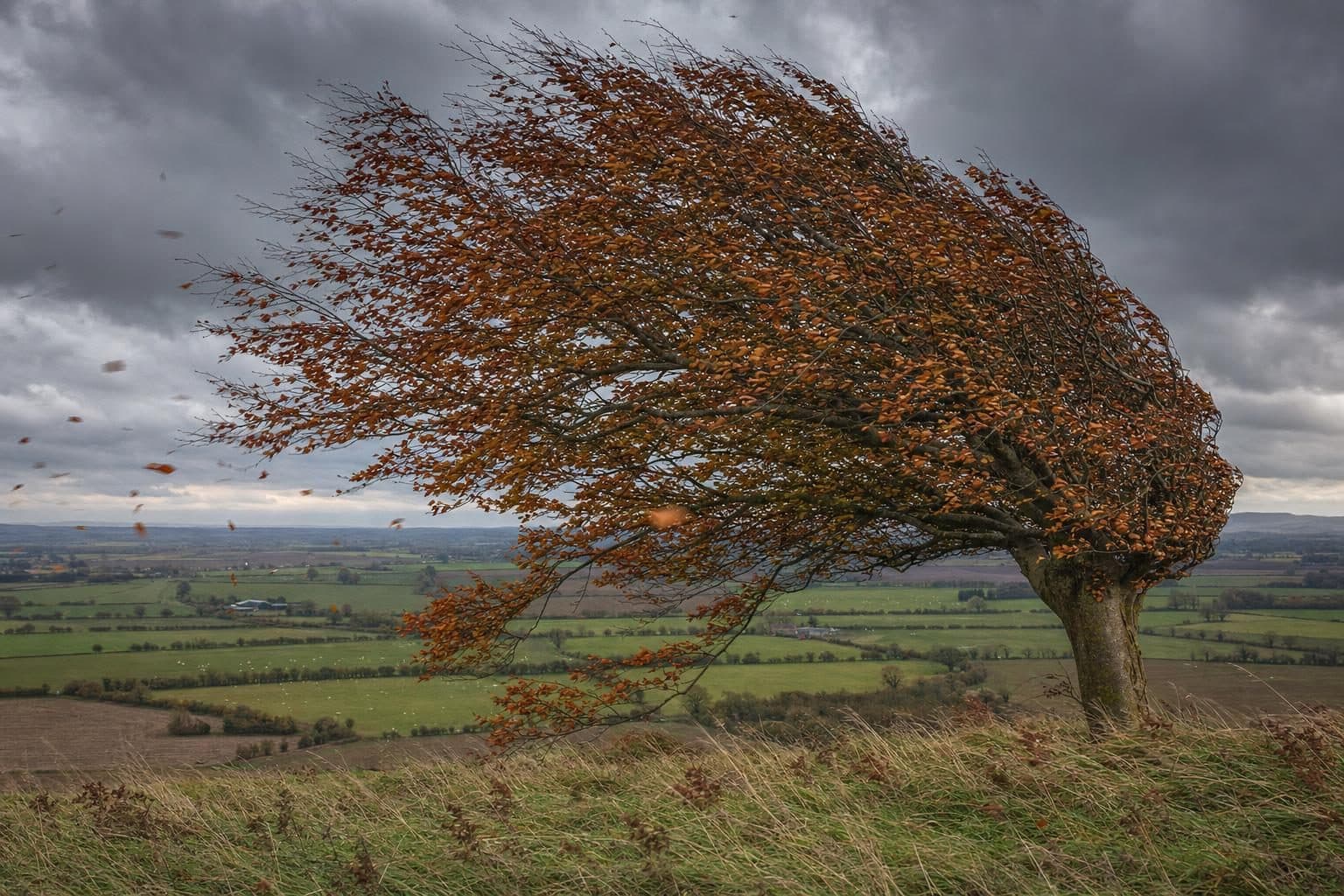
Storm damage looks like bad luck. Usually it is not. The trees that fail in a January gale were nearly always showing something in October, and the work to deal with them was cheaper, calmer and less disruptive then.
Walk your boundary and look up
- Deadwood in the crown. Dead limbs come down first and they come down hardest, because there is no flex left in them.
- Cracks and cavities in the main stem, or where a heavy limb joins it. A crack that opens under load is the classic failure point.
- Lifting soil or a gap at the base. That is the root plate moving, and it is the one to act on immediately.
- Ivy on the stem. Not fatal in itself, but it hides everything above and it adds sail area in winter wind.
- Anything tall and top-heavy standing over a roof, a drive, a road or a boundary.
What actually reduces risk
A crown thin or a proportionate reduction, carried out to BS 3998, lowers wind loading on an exposed tree without ruining its shape. That is skilled work and it is not the same thing as topping. Topping a tree makes it more dangerous within a decade: the regrowth is dense, weakly attached and heavier than what it replaced.
Deadwood removal is usually the cheapest single thing you can do for the risk it takes away.
What is a waste of money
Felling a healthy tree because it is big. Size is not a defect. A large tree in good condition, properly assessed, is often safer than a small neglected one, and it is worth far more to the property.
We quote pre-winter checks free across Dorset. If something has already come down, the emergency line is 07920 146 322, answered 24/7.